
On 12 August there will be a solar eclipse, a rare event that attracts great
interest. However, watching it without proper protection can cause damage to the
retina. At Poliklinika Pavan we want to remind you that the way to enjoy it safely
is very simple: never look directly at the Sun without certified eye
protection.
Note for Croatia: from our region the eclipse will be visible as a partial one,
low over the western horizon, shortly before sunset (in most towns it begins
around 19:25–19:30). In the far west of the country the Moon will cover more than 90% of the Sun’s
diameter. The fact that the Sun is low and appears dimmed does not mean that looking at it is
safe — protection is still essential.
Why is it dangerous to look at a solar eclipse?
During an eclipse sunlight may seem weaker, but it can still damage the retina.
The retina is a very sensitive structure, comparable to a camera sensor: if it directly receives
too much light, it can be injured.
The main risk is solar retinopathy, damage that can particularly affect central vision.
The most important thing to know is that this damage can occur without immediate pain, because the retina has no
pain sensation like other parts of the body.
What kind of eye protection should you use?
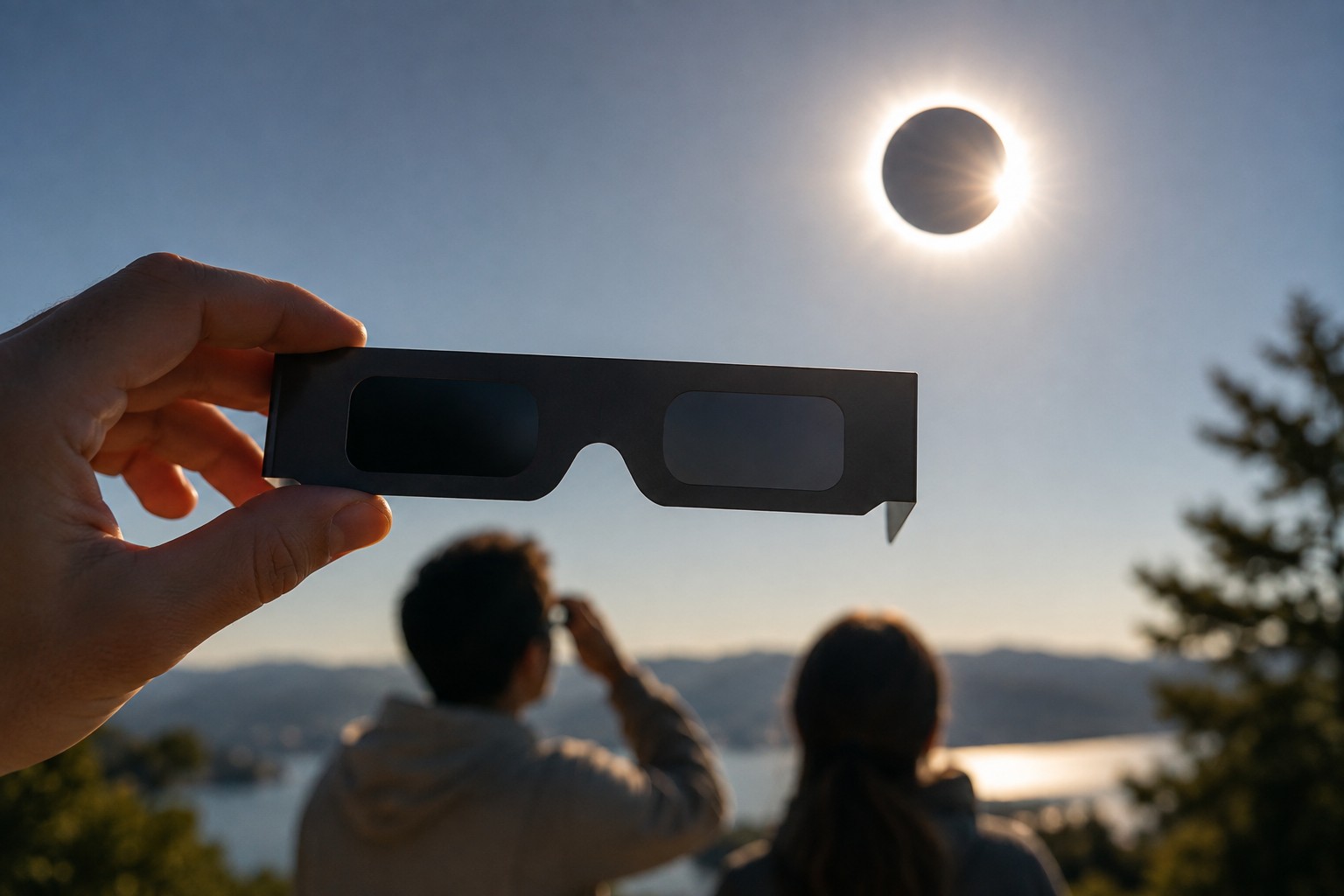
To view the eclipse directly, you must use certified eclipse glasses or
certified solar filters designed specifically for that purpose.
Ordinary sunglasses are not suitable, however dark they are. Improvised filters,
X-ray films, smoked glass and other home-made methods are not safe either.
Before using the glasses, check:
- That they are in good condition, without scratches, cracks or damaged parts,
- That they are certified for viewing the Sun,
- That they fit well and cover both eyes,
- That children use them only under adult supervision.
How to watch the eclipse safely?
The basic recommendation is clear: if any part of the Sun is visible, certified
eye protection is needed.
How to do it correctly:
- Put the glasses on before you look towards the Sun
- Look at the eclipse only briefly
- Look away from the Sun before taking the glasses off
- Supervise children at all times
- Avoid viewing the eclipse through a camera, phone, binoculars or telescope without
special solar filters
The eclipse can also be viewed indirectly, using the projection method. This option is especially useful
for children, schools and people who would rather not look directly at the Sun.
Warning symptoms after watching the eclipse
If visual disturbances appear after viewing, it is advisable to see an ophthalmologist. Some
symptoms may indicate damage to the retina.
The most common warning signs are:
- Blurred vision
- A dark spot or point in the centre of the visual field
- Difficulty reading or focusing
- Straight lines that appear distorted
- Increased sensitivity to light
- Changes in colour perception
At Poliklinika Pavan we recommend that you don’t wait if these symptoms don’t go away.
An eye examination allows the retina to be checked and any damage to be identified.
Special recommendations for children Children can enjoy the eclipse, but they need closer supervision. It is easy for them to take off
their glasses too early, look over the filter or share damaged viewers.
To reduce the risk:
- Explain to them before the eclipse that they must not look at the Sun without protection
- Check that their glasses fit well on their face
- Stay with them throughout the viewing
- For the youngest children, favour indirect methods
- After viewing, check whether they complain of blurred vision, spots or disturbances
At Poliklinika Pavan we understand that an eclipse can be an educational and exciting experience for children. The key is to make eye protection a natural part of the activity.